Discount attribution
Attribute discounts in Discount Magic to campaigns, partners, channels and departments, much like UTM tags, to organize them and see where sales come from.
Last updated 5 days ago
Attribution lets you organize your discounts around the way your business runs: the campaign each one is part of, the partner who gives it out, the channel customers find it through and the team that looks after it. It works much like UTM tags on a link in Google Analytics, but for discount codes.
With your discounts attributed, you can:
Find and filter every discount in a campaign, from a partner or on a channel.
See where sales come from: a discount's orders are credited to its campaign, partner, channel and department.
Give each team its own view of the discounts it runs, so Marketing and Customer service can each report on theirs.
Which plans include discount attribution
Campaigns, partners, channels and departments
A discount can belong to one campaign, one partner, one channel and one department. Each one is optional.
Campaign: the marketing event the discount is part of, such as a summer sale, an always-on welcome offer or a product launch. See Campaigns.
Partner: who you're working with to give out or promote the discount, such as an influencer or an affiliate. See Partners.
Channel: where customers see or receive the discount, and how it's promoted, such as an email campaign or a packaging insert. See Channels.
Department: the team in your business that's responsible for the discount. See Departments.
Attribution is a record in Discount Magic. It isn't sent to Shopify, Klaviyo or your customers, and it doesn't change who can use the discount.
How to attribute a discount
Every kind of discount can be attributed: code or automatic, with one code or many.
Choose a campaign, partner, channel or department
In the Attribution section on the right of the discount's page, click Add to campaign, Add partner, Add to channel or Add to department. If the discount already has a campaign, partner, channel or department, click its name to change it.
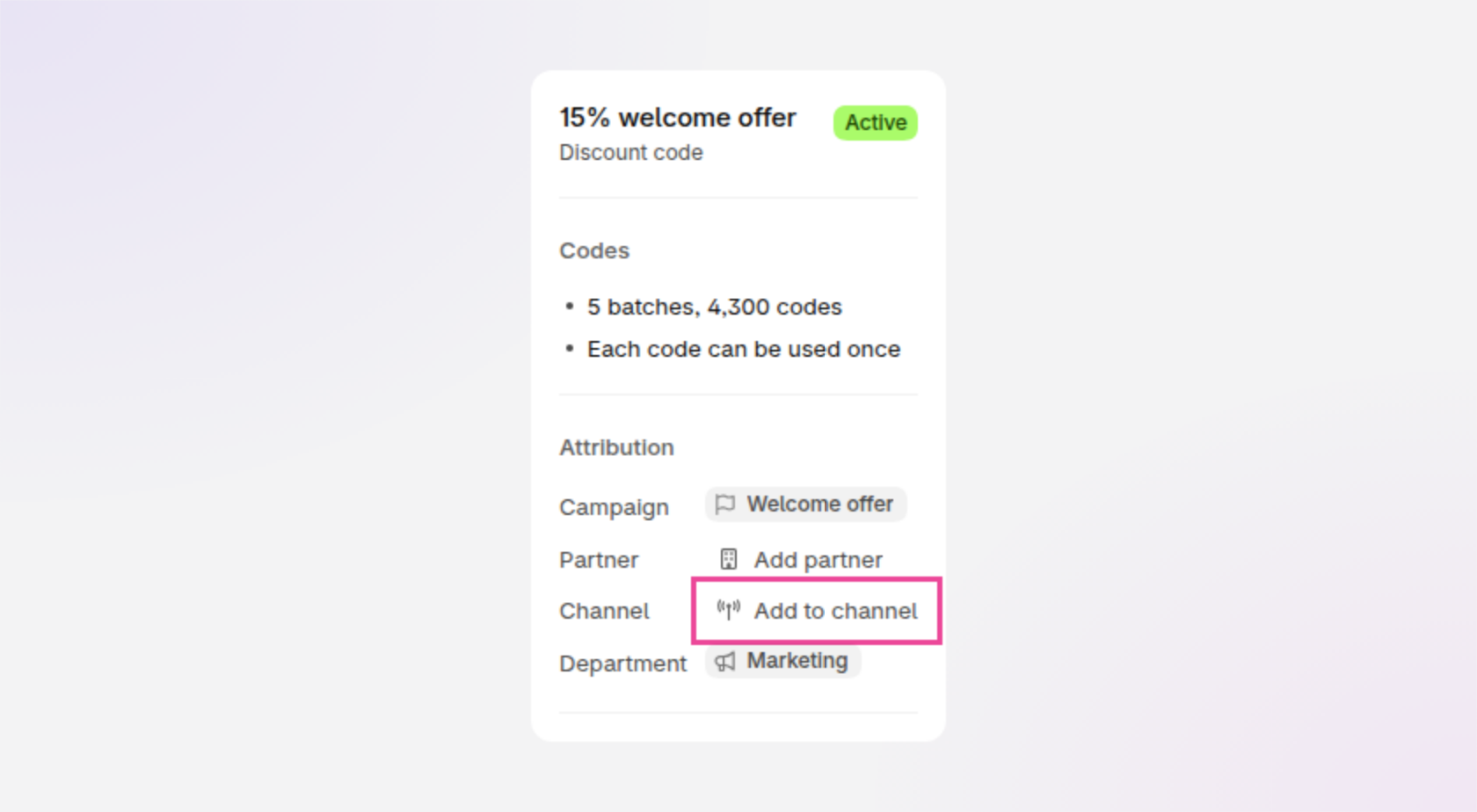
An example of the Attribution section on a discount's page, with Add to channel outlined.
Pick a campaign, partner, channel or department
Click the campaign, partner, channel or department you want, or type to search. To add a new one, type its name and choose Create. To remove the discount's current one, choose the option at the top of the list: No campaign, No partner, No channel or No department.
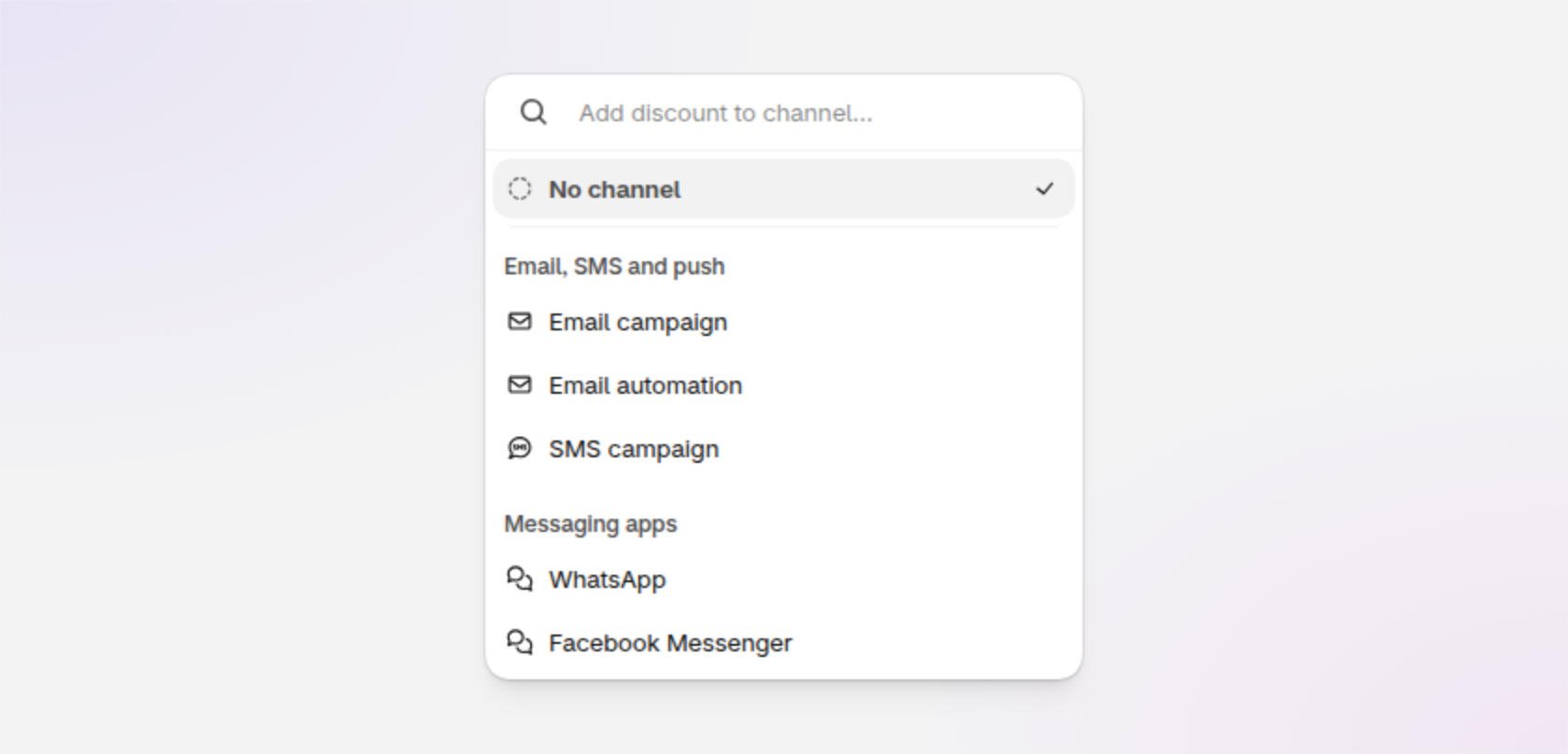
An example of the channel list, with channels under their groups.
Discount Magic saves the change straight away and confirms it with a message such as Channel changed.
How to attribute discounts from the discounts list
On the Discounts page, the Campaign, Partner, Channel and Department columns show each discount's own attribution. To set or change a discount's campaign, partner, channel or department, click it in that discount's row.
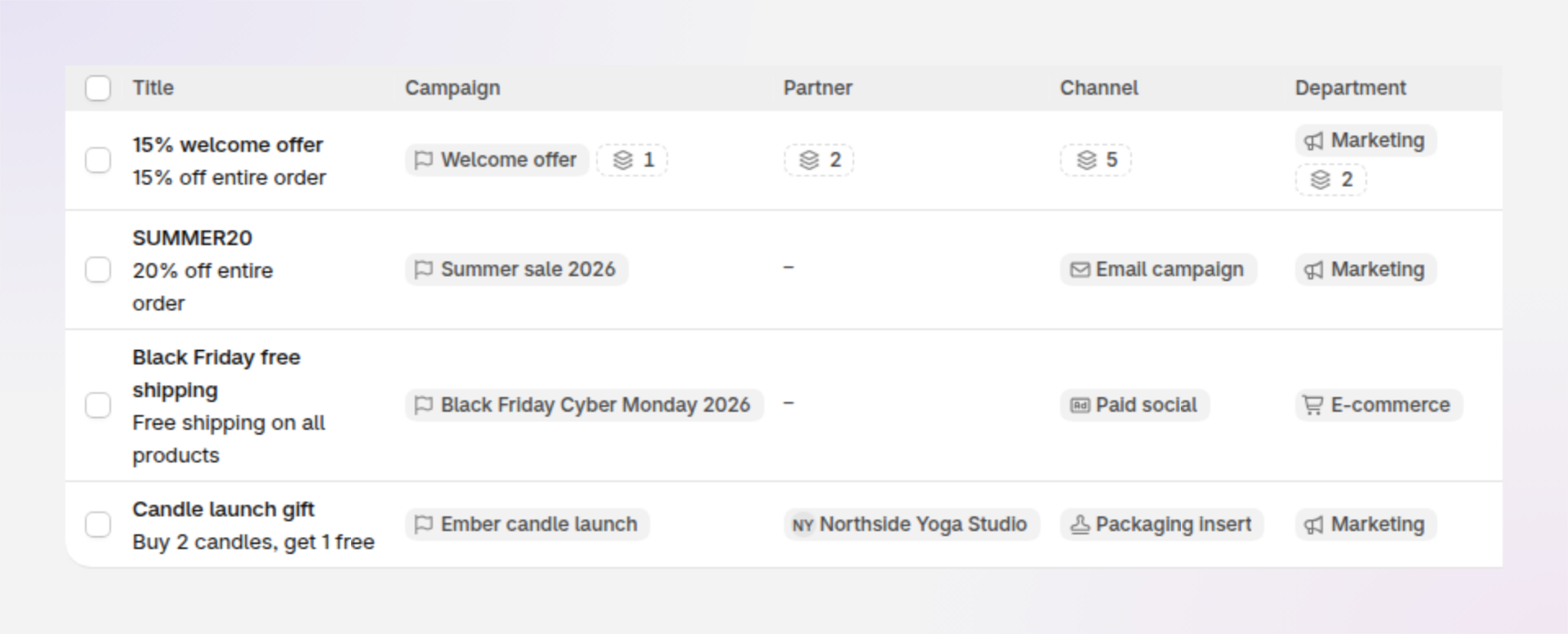
An example of the Campaign, Partner, Channel and Department columns on the discounts list. Other columns are hidden.
A stack icon with a number means the discount's batches have their own campaigns, partners, channels or departments: the number is how many different ones the batches use. Hover over the icon to see the list, or click the icon to open the discount.
Right-click a name to change or remove it, see every discount with it, or open it in Settings.
How to attribute many discounts at once
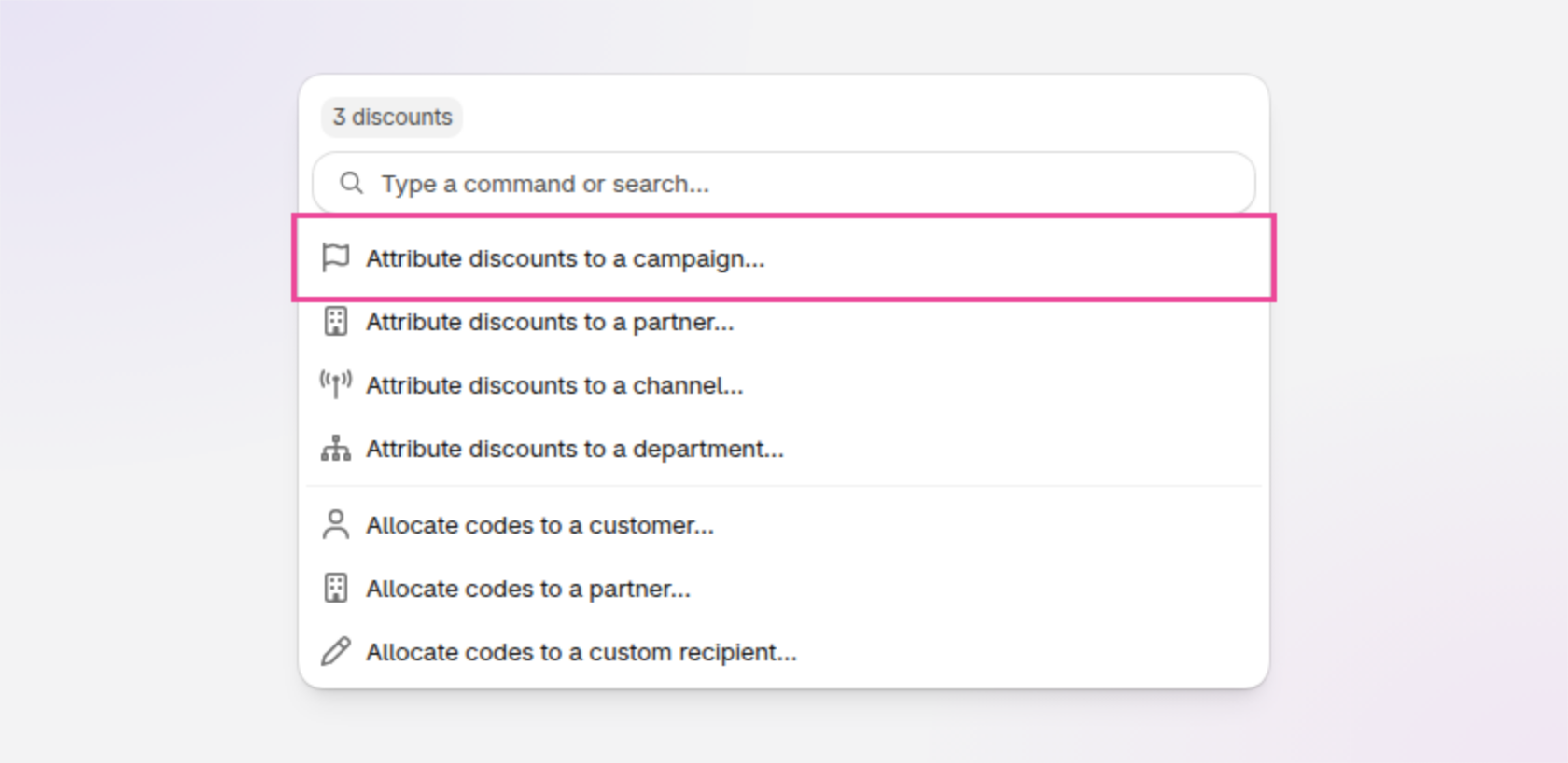
A message confirms the change, such as Campaign changed on 3 discounts, with Undo.
How discount attribution and batch attribution differ
Attribution works at two levels: on a discount, and on each batch of codes inside it. A discount's attribution organizes your discounts, and a batch's groups the codes within one discount, such as a batch for each influencer or each trade show. Both are optional, so you can attribute just the discount, just its batches, both or neither.
A discount with many codes can split them into batches, and each batch can have its own campaign, partner, channel and department. When you create a batch, Discount Magic fills in the batch's campaign, partner, channel and department with the discount's own. After that, the batch's attribution and the discount's are separate: changing the discount doesn't change its batches. See Discount batch attribution.
Sales made with a batch's codes are credited to the batch's attribution. Sales made with a discount's own code, or with an automatic discount, are credited to the discount's.
How to find discounts by campaign, partner, channel or department
On the Discounts page, add a Campaign, Partner, Channel or Department filter.
Tick several in one filter to see discounts with any of them, such as two campaigns.
Use more than one filter to see only discounts that match all of them, such as one campaign and one channel.
Choose No campaign, No partner, No channel or No department to find discounts that haven't been attributed yet.
To come back to a filtered list, save it as a view with Save as…. Hover over a campaign, partner, channel or department name on a discount's page or the discounts list to see how many discounts and batches use it, with a link to those discounts.
How to see who changed a discount's attribution
Every change is recorded in the Timeline at the bottom of the discount's page, with who made it and when. For example: "Sam assigned this discount to campaign Welcome offer".
Frequently asked questions
Does attribution change anything in Shopify?
No. Campaigns, partners, channels and departments are kept in Discount Magic only. Your discounts work at checkout exactly as before.
Can a discount belong to more than one campaign?
No. A discount belongs to one campaign at a time. To track one offer across several campaigns or channels, give it a batch of codes for each.
How is attribution different from allocating codes?
Attribution organizes a whole discount by campaign, partner, channel and department. Discount code allocation records who each individual code was given to, such as a customer.
Do I have to attribute both a discount and its batches?
No. Attribution is optional on both. Attribute the discount to organize your discounts, its batches to tell apart the codes within it, or both. See How discount attribution and batch attribution differ.
Can I see sales by campaign or channel?
Yes, on the Pro plan. On a discount's page, the Performance section can break the discount's orders down by campaign, partner, channel or department. See Discount performance.
Related articles
Was this helpful?
Still need help? Ask the team